
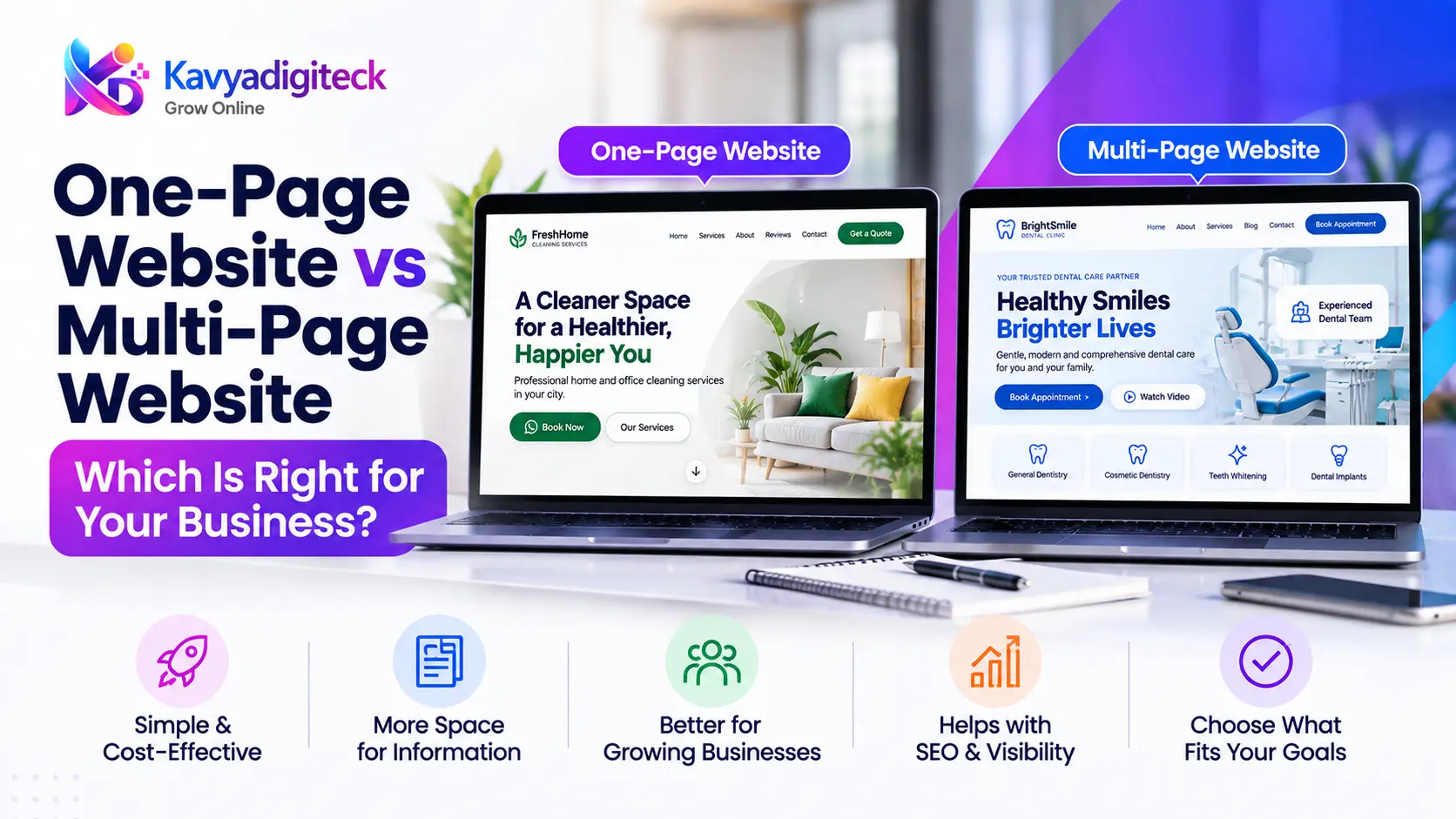
Choosing the right website structure is one of the first decisions a business owner needs to make when building an online presence. Should you start with a simple one-page website, or would a multi-page website be a better investment?
There is no universal answer. The right choice depends on your business type, the amount of information you need to present, your goals, and how you expect the business to grow.
For a local professional, consultant, small service provider, or newly established business, a one-page website may be more than enough. On the other hand, businesses with multiple services, products, locations, or content requirements may benefit from a multi-page website.
Let’s look at the differences and help you decide which option makes sense for your business.
What Is a One-Page Website?
A one-page website presents the important information about a business on a single webpage.
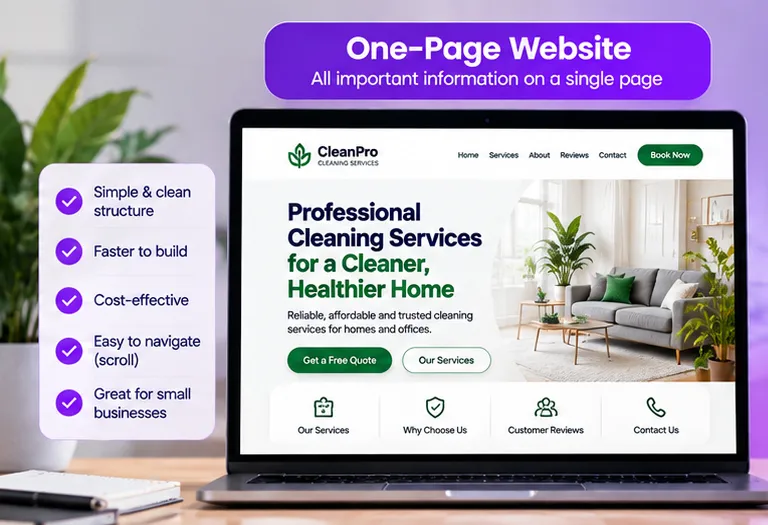
Instead of clicking through several pages, visitors scroll through different sections such as:
- Introduction or hero section
- About the business
- Services
- Why choose us
- Testimonials
- Frequently asked questions
- Contact information
- Location and map
- Call, WhatsApp, or enquiry buttons
A well-designed one-page website can give visitors everything they need to understand your business and take the next step.
For example, a local physiotherapist might have a single page containing information about the clinic, treatments, experience, patient testimonials, location, and an appointment form.
Who Is a One-Page Website Suitable For?
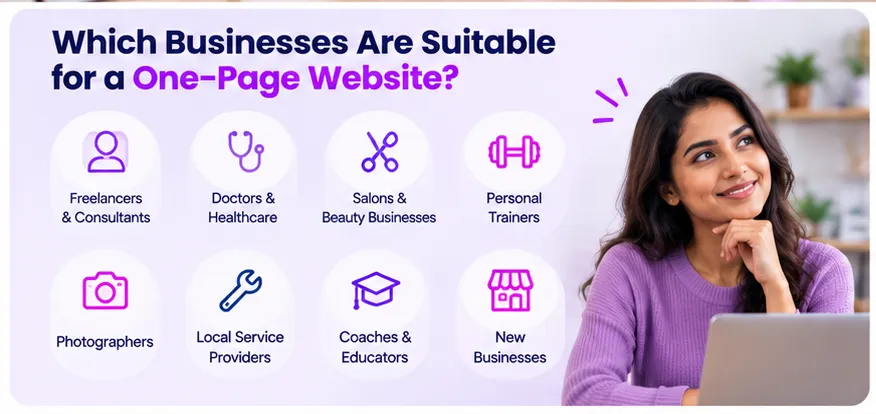
A one-page website can work particularly well for:
- Freelancers
- Consultants
- Doctors and healthcare professionals
- Photographers
- Personal trainers
- Coaches
- Local service providers
- Small salons and beauty businesses
- Home-service businesses
- New businesses
- Professionals who primarily generate enquiries through phone or WhatsApp
If your business has a relatively small amount of information and one main goal—such as getting calls, enquiries, bookings, or WhatsApp messages—a one-page website can be an excellent starting point.
What Is a Multi-Page Website?
A multi-page website separates information into individual webpages.
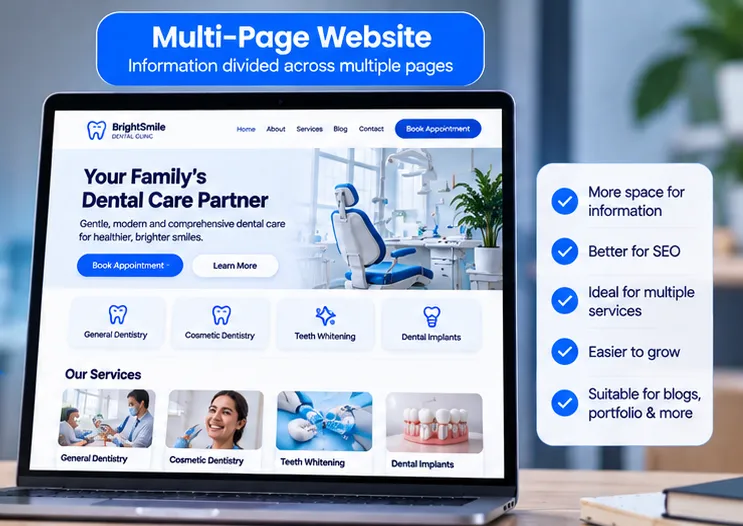
For example, a typical small business website might have:
- Home
- About Us
- Services
- Individual service pages
- Projects or Portfolio
- Blog
- Testimonials
- Contact Us
Each page has its own URL and focuses on a particular topic.
This structure gives businesses more space to explain their services, demonstrate expertise, publish content, and target different search queries.
A growing electrical contractor, for example, might have separate pages for residential wiring, commercial electrical work, electrical maintenance, solar installation, and other services.
One-Page vs Multi-Page Website: The Key Differences
The biggest difference is not simply the number of pages. It is how much information your business needs to communicate and how visitors will navigate it.
| Feature | One-Page Website | Multi-Page Website |
|---|---|---|
| Structure | All information on one page | Information divided across pages |
| Cost | Usually lower | Usually higher |
| Development time | Faster | More time required |
| Navigation | Mostly scrolling and anchor links | Page-to-page navigation |
| SEO opportunities | More limited | More extensive |
| Best for | Simple businesses | Growing/complex businesses |
| Services | Several services can be shown in sections | Each service can have its own page |
| Blog | Usually unnecessary | Easy to integrate |
| Scalability | Limited | Easier to expand |
| Maintenance | Generally simpler | More content to maintain |
Neither option is automatically better. The important question is which structure fits your business goals.
Advantages of a One-Page Website
1. Simple and Easy to Navigate
Visitors don’t have to figure out where to go. They can simply scroll through the page and find the information they need.
For businesses with straightforward offerings, this can create a very smooth customer journey.
2. Faster to Build
Because there are fewer pages and less content to organize, a one-page website can generally be designed and launched faster.
This can be particularly useful for a new business that wants to establish an online presence quickly.
3. Cost-Effective
A smaller website usually requires less design and development work. That can make a one-page website a practical option for businesses with a limited initial budget.
Instead of waiting until you can afford a large website, you can start with a professional one-page site and expand later if your needs change.
4. Focused on One Main Goal
A good one-page website can guide visitors toward a specific action:
Call → WhatsApp → Book → Enquire
This makes it particularly useful for businesses that rely on direct customer enquiries.
Limitations of a One-Page Website
A one-page website isn’t perfect for every business.
If you have dozens of services, a large product catalogue, multiple locations, detailed case studies, or regular articles, putting everything on one page can make the website difficult to navigate.
SEO can also be more limited because you have fewer individual pages targeting different topics and search queries.
Most importantly, a one-page website can become too long if you keep adding information.
Simple is good. Overcrowded is not.
Advantages of a Multi-Page Website
1. More Room for Information
Each page can focus on one subject.
For example:
Home → Overview
About → Business story and experience
Services → Services overview
AC Repair → Detailed AC repair information
Installation → Installation information
Contact → Enquiry and location
This makes the information easier for visitors to understand.
2. Better SEO Opportunities
A multi-page website gives you more opportunities to create useful, focused content.
Instead of trying to explain every service on one page, you can create dedicated pages around important services and topics.
For example, an electrician could have pages targeting:
- Electrical wiring
- Home electrical repair
- Commercial electrical services
- Electrical maintenance
Each page can provide genuinely useful information about that particular service.
3. Easier to Grow
A business rarely stays exactly the same.
You may start with three services and eventually offer ten. You may add an online store, portfolio, blog, booking system, or additional locations.
A multi-page structure makes these additions easier to organize.
4. Better for Content Marketing
If you plan to publish regular articles, guides, case studies, or industry information, a multi-page website is generally the better foundation.
Your blog can also support your service pages by answering questions potential customers search for.
When Should You Choose a One-Page Website?
A one-page website is probably the right choice if:
- You have a small number of services
- Your business is new
- You mainly need calls, WhatsApp enquiries, or bookings
- You have a limited amount of content
- You want to launch quickly
- You don’t need a blog
- You don’t have an extensive product catalogue
- Your primary customers are local
For many small businesses, starting with one excellent page is better than launching a large website filled with unnecessary content.
When Should You Choose a Multi-Page Website?
Consider a multi-page website if:
- You offer many different services
- Each service needs detailed explanation
- You want to invest seriously in SEO
- You plan to publish blog articles
- You have multiple locations
- You sell many products
- You need a portfolio or project section
- Your business is growing
- You expect the website to become an important marketing channel
In these situations, separating information into dedicated pages can provide a much better experience.
What About a 3–5 Page Business Website?
There is also a useful middle ground between a single-page website and a large corporate website.
For many local businesses, a 3–5 page website is enough.
A typical structure could be:
Home
Introduce the business and highlight the main services.
About Us
Explain your experience, story, and approach.
Services
Describe your main services and capabilities.
Projects / Testimonials
Show previous work or customer experiences.
Contact Us
Provide phone, WhatsApp, location, opening hours, and enquiry options.
This approach gives a business more room than a one-page site without creating unnecessary complexity.
Should You Start Small and Expand Later?

Absolutely.
Your first website does not have to be your final website.
A new business could start with a professionally designed one-page website and later add:
- Dedicated service pages
- Blog
- Portfolio
- Online booking
- E-commerce
- Additional locations
- Customer resources
What matters is that the initial website is built with future growth in mind.
Starting small can be a sensible strategy when your immediate goal is simply to establish credibility and start generating enquiries.
How Much Does the Type of Website Matter for SEO?
Website structure matters, but more pages do not automatically mean better SEO.
A website with ten useful pages can be much more valuable than a website with fifty thin or repetitive pages.
The focus should be on creating useful content that answers what your potential customers are actually searching for.
A one-page website can still have good basic SEO for a local business. However, businesses targeting multiple services, locations, and topics will generally have more opportunities with a properly structured multi-page website.
How to Choose the Right Website for Your Business
Before choosing, ask yourself these five questions:
1. How many services do I offer?
If you have only a few straightforward services, one page may be enough.
2. Do customers need detailed information?
If each service requires its own explanation, separate pages may be better.
3. Do I want to invest in SEO and content?
If yes, a multi-page structure gives you more room to build useful content.
4. What is my primary goal?
Do you mainly want:
- Phone calls?
- WhatsApp messages?
- Appointment bookings?
- Quote requests?
- Online sales?
Your website structure should support that goal.
5. Where will the business be in two or three years?
Don’t only think about what you need today. Consider whether the website will need to accommodate new services, products, locations, or content.
Final Thoughts
There is no competition between a one-page and multi-page website. The best website is the one that matches the needs of your business.
A one-page website can be an excellent choice for a small local business that needs a professional online presence without unnecessary complexity.
A multi-page website makes more sense when you have more services, more information, stronger SEO ambitions, or plans for long-term growth.
And for many small businesses, a 3–5 page website can provide the ideal balance between simplicity, cost, information, and future growth.
The goal isn’t to build the biggest website possible. The goal is to build a website that helps your customers understand your business, trust you, and take the next step.
Need help deciding which website is right for your business?
Kavyadigiteck helps small businesses and professionals build practical, modern websites designed around their actual requirements. Whether you need a simple one-page website, a landing page, or a complete multi-page business website, the right starting point is understanding what your customers need.
Start with what your business needs today—and build with tomorrow in mind. Feel Free to Contact Us